
Food plays a very important part in Nepalese life. A typical way to greet one other in Nepalese is saying Khana khanubayo, meaning “Have you eaten already”? Nepalese food habits traditionally focus around vegetarian dishes with meat only consumed occasionally, particularly at festival time. Depending on caste and tribal background, Nepalese are vegetarian or consume goat meat, chicken, fish, water buffalo or pork.
 Over time, and with many Nepalese traveling abroad, food consumption patters have changed with international food influences from all over the world having entered the Nepalese kitchen. Nevertheless, the traditional Dal Bhat (rice with pulses) is still the main staple in many Nepali homes, and typically served on a steel plate. The Nepal Cookbook includes an extensive overview of recipes, representing the best of the authentic Nepali cuisine. You will find recipes of festival dishes as well as everyday favorites.
Breakfast; just try a new start of the day
Traditionally, Nepalese eat two main meals daily, with rice or roti. The first meal is taken late in the morning. Earlier in the morning at breakfast time Nepalese typically have tea with some small snack or bread in urban areas. Food patterns are changing with families in urban areas adopting a more western style for breakfast.
Khir (rice/milk pudding) is eaten as a sweet breakfast or as a snack. Khir is also an important festival food, and is used at baby rice-feeding, called Pasni, the first time babies eat solid food.
Puri (a deep-fat fried bread made from wheat flour) is eaten for breakfast or as a snack, served with a curry of a mixture of vegetables, peas and potatoes. It is a good change to try for breakfast, particularly to start the day in winter time.
Lunch and dinner; try the traditional Dal Bhat
Dal Bhat, rice with pulses, is the staple food many Nepalese families eat for lunch and dinner. It is often served with vegetables (tarkari) and some pickle (achar). It is mostly taken as a vegetarian dish, with meat only added occasionally in the weekends or at festivals. Many families have rice for lunch and change it at times with roti for dinner.
Dal Bhat is cooked fresh for every meal. All ingredients are cooked very well which makes it a safe dish to eat when you are traveling.
Festival food and snacks; some of them you will like
The first snack to look at in Nepal are Momos, this is a have to try during your visit. It are dumplings with different types of stuffing on a vegetarian non-vegetarian basis. Momos can be steamed or fried.

Chiura, or “bitten rice” is a popular traditional food of Nepal made of paddy. It is particularly popular with the Newar community and often eaten in combination with Dahi (Yogurt).
Yomari is made by kneading rice flour in a fig shape and fill it with Chaku (sweet mix with black sesame)
Sel Roti is cooked for most festivals, but particularly during the Tihar festival, which marks the victory of good over evil. and is popular with almost all ethnic groups. It is one of my favorites when I’m on the road and like to have a quick snack at a teashop. 
Jeri (Jilebi) is another (sweet) snack, on flour, curd and saffron basis that is very popular in the country and available in many Nepalese homes during festivals and at teashops. It is also nice to eat in combination with yoghurt (dahi).

Malpuwa is usually eaten as a snack and at festivals and pujas (worships). Iyt can best be described as fritters or pancakes, served as a dessert or a snack
Maasko bara is another popular snack food used at many religious ceremonies and festivals. It is made on a basis of black lentils.
Chana is a snack of roasted chickpeas and popular throughout the country.
Bhatmas Sandeko is a soya bean salad made by mixing garlic and ginger with soybean. It is commonly eaten with cheura as a side dish to the main meal or as a snack. Another popular snack is roasted dry soybeans.
Dhido, a buckwheat porridge found at remote trekking lodges, is another altitude-friendly staple worth seeking out — hearty, simple, and deeply satisfying after a long day’s hike.
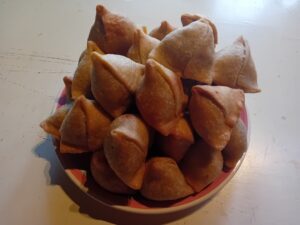
Samosa is the crispy triangular staple of the country’s vibrant street food scene. These golden pastries, typically filled with spiced potatoes and peas, offer a milder, uniquely Nepali twist on Indian flavors, making them a perfect introduction to local cuisine.
Kwati represents a vibrant traditional soup, crafted from nine distinct sprouted beans. Originating within the Newar community of the Kathmandu Valley, the term merges ‘Kwa’ (hot) and ‘Ti’ (soup). Travelers visiting in August may encounter this delicacy during Gun Punhi, coinciding with the Hindu Janai Purnima festival. Beyond its ritual importance, Kwati is celebrated for substantial nutritional benefits. Rich in protein, it is traditionally believed to assist recovery and restore vitality. For tourists exploring Nepalese heritage, sampling Kwati provides an authentic insight into local culinary customs.
Food habits and cultural practices you need to know
Nepalese traditionally eat by hand. They use their right hand for this, as the left hand is considered “contaminated” as it is used for cleansing purpose while going to the toilet. Food should therefore be handled with your right hand, while you eat or when you pass it on to someone.
When you have touched your fingers to your mouth, you are not supposed to touch food at a common plate or passing it on to someone else anymore. This is also considered to be “contaminated” . So, if something touches your mouth, it is instantly jhuto and can no longer be consumed by anyone else. Also, after your hand has touched your mouth when eating, that hand and your food are now contaminated.
Enjoying the Nepalese traditional food experience
If you like to enjoy a typical Nepali food experience, try to find a Thakali restaurant. Thakali people are an ethnic group from the Mustang area. They are well-know in Nepal for their cuisine and food hygiene. They typically serve a Dal Bhat (rice with pulses) served with vegetables and meat if you like.
The indigenous ethnic group of the Kathmandu valley, the Newaris, are well-known in Nepal for their kitchen. here you can also have the Dal Bhat dish, and several authentic and exotic dishes.
Top Thakali Restaurants:
- Jimbu Thakali, Multiple locations across Kathmandu Valley. Known for consistently excellent dal bhat and standout chicken curry.
- Tukche, Highly praised by locals, repeatedly recognized as serving the best Thakali chicken curry in Kathmandu.
- Mantra Thakali Chamika — A community favorite, topping community votes as the premier Thakali dining spot in the city.
Newari Cuisine in the Kathmandu Valley
Explore authentic Newari food at Bhaktapur Durbar Square, Patan’s old city, and the Boudha Stupa area, where generations-old stalls serve chatamari and bara — dishes that have barely changed in centuries.
Top Newari Restaurants:
- Harati Newari Restaurant, rating: 4.9/5 on TripAdvisor. Renowned for authentic Newari dishes, friendly service, and vibrant ambiance.🔗 Read Reviews
- Paalcha Newari Kitchen, celebrated for its delicious yomari, hearty dal bhat, and excellent value. 🔗 Read Reviews
.If you like to combine a culinary experience with a cultural exposure, then a visit to such restaurants that cater for this combination enjoying good food, traditional dances and music is for you. Nepali Chulo at Lazimpath in Kathmandu is one of the restaurants in a traditional old Rana palace that offers such possibility.
Modern Fusion: Culinary Innovation
Rohini “Dolly” Rana’s third cookbook, Memories on a Platter, represents an exciting evolution of Nepali cuisine. It combines traditional Nepali flavors with influences from her childhood in India and menus sampled worldwide from the time she was living abroard.
Notable Fusions Include:
- Khir with Alu Bakhada sauce (presented as Rice Pudding with Plum Coulis)
- Quinoa Pulao and Idli Hamburger
- Buckwheat Crêpe (incorporating dhido principles)
- Mutton Gravy with Scones
- Grilled Steak with Sichuan Pepper (reimagining traditional braised wild boar)
These innovations demonstrate how traditional elements can be adapted for modern palates without losing their cultural essence. For instance, samosas are combined with Turkish Sambousa and Lebanese Sambousek, while Gol Gappa experiments include scrambled eggs and smoked salmon fillings. For an in-depth look at this cookbook, check out this article from Nepali Times.
Immersive Homestay Experiences
For a more profound culinary immersion, consider staying with local families through homestay programs. At places like Himanshu Homestay and Balthali Homestay, hosts guide guests step-by-step through preparing traditional dishes, teaching the secrets behind local spices and organic, farm-to-table ingredients. At Barang Village Community Homestay, you might harvest corn on terraced fields before cooking it in a rural kitchen. These experiences blur the line between tourist and temporary family member, turning a gastronomic adventure into something deeply personal.
Cooking Classes and Food Tours
To truly master Nepal’s culinary arts, join a food tour or cooking class that typically starts with a guided visit to bustling markets like Asan or Indrachok on Kathmandu or in Pokhara . Under expert guidance, you’ll learn to select fresh ingredients and traditional spices before rolling dough for momos or grinding masala by hand. Many operators offer flexible booking through platforms like GetYourGuide, Viator, and Cookly. You’ll leave not only with a meal you prepared yourself but with the practical skills to recreate vibrant Nepali flavors at home.
Note: Restaurant ratings and availability may change. Always verify current information before visiting.