
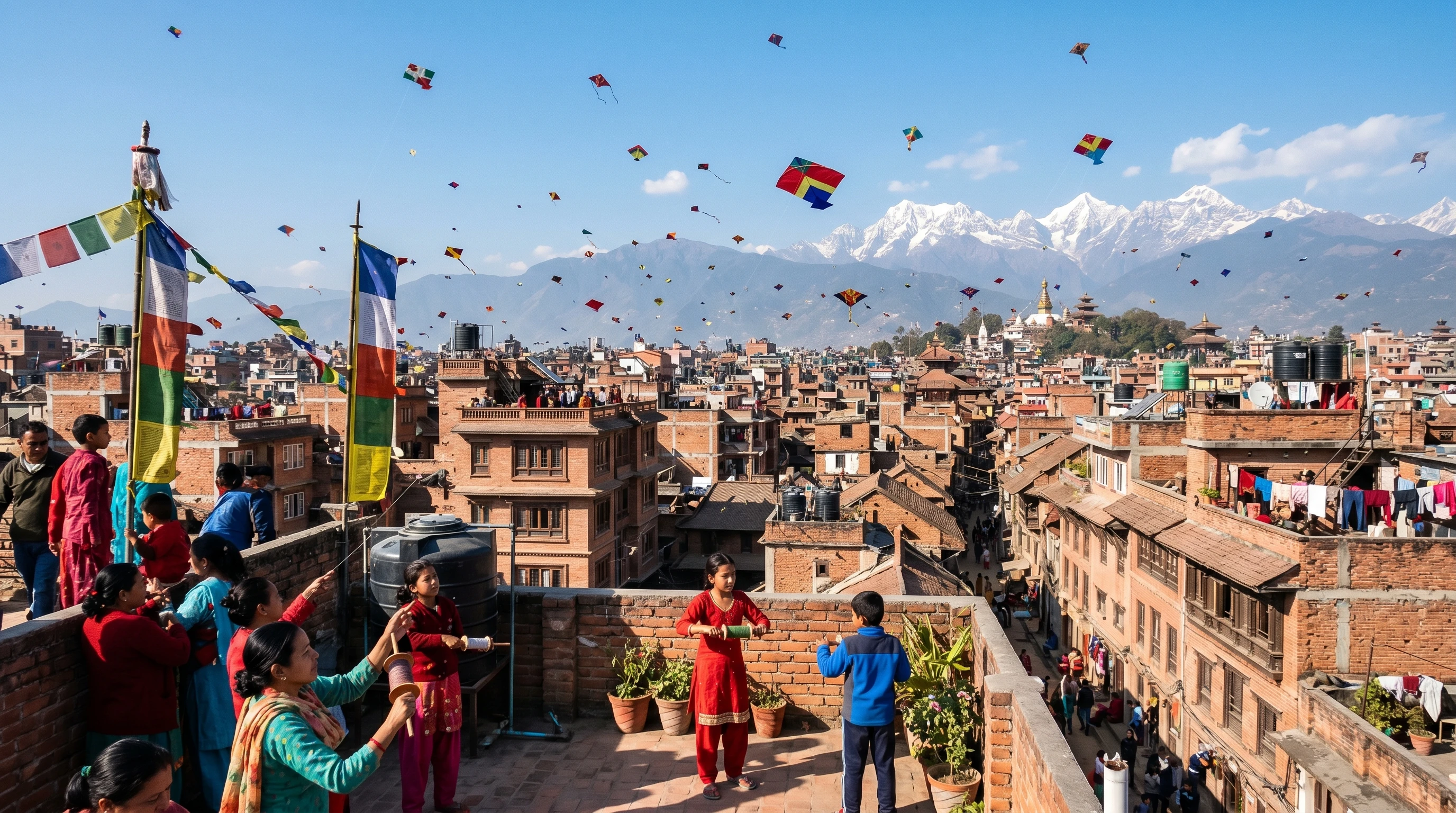
The skies above Kathmandu transform every year when the monsoon draws back and the autumn breeze picks up. Rooftops fill with families, teenagers, and childhood friends, all focused on a single goal: launching their paper kites into the sky. Flying kites in Kathmandu isn’t just a lazy afternoon activity. It’s a full-blown competitive ritual that feels more like a martial art than a pastime. The kite season is full of friendly rivalry, clever tricks, and sky-high strategy.
The World of Kathmandu Kite Flying
Kite season is more than just a scheduled tradition; it’s a whole atmosphere that settles across the city each autumn around the Dashain festival time. Kite flying mixes fun with a bit of drama, making it an unforgettable memory for all practising it.
There’s a connection in the air as neighbors call out to each other, proud or playful, while parents teach kids the basics and older kids show off slick tricks learned through years of trial and error. The city comes alive as the rooftops fill with chattering families flying their kites.
Kite Fighting: Kathmandu’s Martial Art in the Sky
Kite battles in Kathmandu come with their own set of rules. Unlike kite flying in other countries where the real joy is in watching the kite float, in Nepal, it’s pretty much all about strategy and winning. The prize goes to whoever manages to slice through the line of another flyer’s kite, sending their rival floating away like a fallen flag. This takes skill, patience, and a quick movement of the wrist.
- The Kites: Nepali kites are light, super responsive, and often imported from Lucknow, India. These kites handle sharp turns and fast dives, making them perfect for quick aerial battles.
- The Lattai (Spool): Every rooftop warrior has their favorite lattai, the wooden spool that controls the line. It’s all about perfect timing and steady hands; reeling in too quickly or letting the line slack at the wrong second can lose you the fight instantly.
- Combat Ready Line (Maajhaa): The real secret weapon is the maajhaa: a thread coated in gum, crushed glass, and sometimes secret ingredients only families know. This glass line lets you slice another line clean, if you know what you’re doing.
One mistake you’ll never forget after your first battle: always keep just the right amount of tension on the line, or your kite could take an instant nosedive. Let your guard down for even a moment and you’ll be watching your kite sail away in someone else’s hand.
The Craft and Chemistry of Maajhaa
Making the strongest line is like a project, often involving boiling aloe vera, grind glass, and mix up batches of glue and rusty resin. The mix is tested to see if can slice through a line. The best maajhaa is sharp enough to cut, but not so brittle that it will break inside the lattai, it’s almost like a science experiment.
Rooftop Tactics: Surviving Kathmandu’s Urban Battlefield
Kathmandu’s packed rooftops shape how most people fly their kites. You don’t have the wideopen fields you see in countryside villages; you have water tanks, TV antennas, and closenit neighborhoods contending for space. Pulling the kite up quickly, dodging obstacles, and keeping an eye out for neighboring flyers is all part of the challenge. When you finally gain altitude, the real battles start, with lines crisscrossing so close that tangles and accidental mishaps are almost impossible to avoid.
In less dense areas on Kathmandu’s edge, you sometimes see field flyers who can run with their kites and catch higher winds. But, there’s nothing quite like the cluster of colorful paper cutting across a maze of rooftops, with families shouting advice. The city’s unique layout turns every successful launch or daring rescue into an instant victory. You quickly learn which rooftops have the best winds.
The Physics Underneath the Magic
Kite flight may seem almost magical when that first launch catches the wind, but it’s all rooted in basic aerodynamics. The shape of the kite is designed to balance the four main forces at work: lift, gravity, drag, and line tension. Knowing how to tilt your kite, how to adjust with sudden gusts, and how hard to tug on the lattai helps you keep your kite in the sky and in control.
Kite Flying Worldwide: Nepal’s Unique Twist
Kites show up just about everywhere in world history, from China’s ancient paper creations and Indonesian ceremonial flights to the story of Marconi using a kite for a radio antenna. Nepali kite fighting, though, stands out for its blend of competition, skill, and oldschool paper craft. Every year, Nepal’s flyers travel abroad to compete in international kite festivals, showing off spinning dive moves and victory dances that can only come from home rooftops. If you ever see Nepal represented at an event like the Dieppe International Kite Festival in France, expect a whole different level of competitive spirit from the Valley’s champions. Nepali flyers often surprise international audiences with splitsecond moves and their passionate approach to sky duels, making them memorable on the world stage.
Elsewhere, kite flying might be about grace or artistry. In Japan, immense and highly decorated kites wow crowds with their beauty, while in Brazil, kids battle using razor-sharp lines in high-stakes competitions. India’s Makar Sankranti festival floods the sky with thousands of kites, but the chaotic, close-quarter rooftop skirmishes of Kathmandu add a layer of intensity and creative improvisation that’s hard to match. The city’s kite culture shows a neighborhood pride and a playful sense of rivalry appreciated by all who take part.
Kite Culture: More Than Just a Game
Kite flying in Kathmandu is the perfect blend of craft, competition and community. It starts with carefully choosing a kite at places like the Asan Bazaar to passing down secret maajhaa recipes. The whole experience bonds families and friends during the autumn months. Younger kids team up with older ones, and generations reconnect while surveying the city from up high. The sky over Kathmandu becomes a patchwork of color, movement, and laughter, proof that this “martial art of the Nepali sky” is a shared celebration that never gets old.
Quick Tips If You Want to Join Kathmandu’s Kite Action
- Choose a lightweight, responsive kite. These are easier to maneuver and more forgiving for beginners.
- Practice your spool (lattai) skills. Quick wrist action is the secret to sharp dives and last-minute rescues.
- Use a homemade or quality maajhaa line. The right glass line is the difference between a quick loss and a long string of rooftop wins.
- Keep an eye out for rooftop obstacles. If you win a duel, reel your kite in fast.
- Never fly in heavy wind or rain. Nepal’s autumn weather is perfect for steady breezes most days, but rough conditions can snap lines and ruin the fun.
- Ask locals for advice. Flyers on Kathmandu’s rooftops are usually happy to share tips, show you how to tie a good knot or help tune up your technique; it’s a welcoming community for both locals and curious travelers.
Frequently Asked Questions About Kathmandu Kite Flying
What’s special about Nepali kite fighting compared to other countries?
Answer: Nepali kite fighting is super competitive, with an emphasis on cutting the other flyer’s line instead of just floating. The use of glass-coated maajhaa makes it more combat-oriented than most.
Do people really make their own kite line?
Answer: Yes! While store-bought line is easy to use, lots of families still mix up their own maajhaa using age-old recipes and techniques.
Are there any safety concerns?
Answer: A few! Avoid busy roads for chasing cut kites, and be careful with the glass line; it’s sharp. Rooftop boundaries can also be risky during heated battles.
When is kite flying season in Kathmandu?
Answer: It’s biggest during the post-monsoon autumn months, especially around Dashain festival, but you’ll see kites anytime the sky’s clear and the breeze is right.